St. Kilian
Patronage; sufferers of rheumatism
St. Kilian (640-689), also known as St. Cillian, was born to a noble family in Ireland. As a child he was known for his piety and love of study, which led him to the priesthood. He became a traveling bishop on the island, and in 686 left Ireland with eleven companions to travel throughout Gaul (present day France and parts of Germany) to preach the Gospel. From there he traveled to Rome to get official sanction from the Pope to become a missionary. St. Kilian returned north and settled in Würzburg as his base of activity along with two of his original companions. He began his work evangelizing the pagans in large parts of Franconia and Thuringia (north and central Germany), earning the name 'Apostle of Franconia.' Saint Kilian converted the Duke of Würzburg and convinced him to end his unlawful marriage. This greatly angered the Duke's wife, who resisted St. Kilian's attempts to convert her. While the Duke was away she had St. Kilian and his two missionary companions beheaded while they were preaching. A cathedral was built on the spot of martyrdom by the first bishop of Würzburg. On St. Kilian's feast day, his relics, along with those of his two companions, are paraded through the streets and put on display in the Würzburg Cathedral that is dedicated to him.
Photo: View from Old Main Bridge in Würzburg towards Festung Marienberg. St.Kilian in front with his golden sword.
Specializing in Stained Glass Patron Saint Gifts for Children and Adults. Find your favorite Saint! If you can't find them email me at RecycledCatholic.gmail.com Or visit me at etsy.com TheRecycledCatholic shop Catholic Gifts, First Communion, Baptism, Wedding, Priest Gifts, and for everyday prayer. Hand Soldered Stained Glass Holy Cards, Prayer Cards, Patron Saints, and Rosary Jewelry Gifts. A unique gift you will not find anywhere else!
Showing posts with label saint of the day. Show all posts
Wednesday, July 8, 2015
Saturday, October 4, 2014
Saint Francis Saint of the Day! Oct 4
Saint of the Day! Oct 4
Saint Francis
Patron Saint of: Animals
Ecology
Italy
Merchants...
Francis of Assisi was a poor little man who astounded and inspired the Church by taking the gospel literally—not in a narrow fundamentalist sense, but by actually following all that Jesus said and did, joyfully, without limit and without a sense of self-importance.
Serious illness brought the young Francis to see the emptiness of his frolicking life as leader of Assisi's youth. Prayer—lengthy and difficult—led him to a self-emptying like that of Christ, climaxed by embracing a leper he met on the road. It symbolized his complete obedience to what he had heard in prayer: "Francis! Everything you have loved and desired in the flesh it is your duty to despise and hate, if you wish to know my will. And when you have begun this, all that now seems sweet and lovely to you will become intolerable and bitter, but all that you used to avoid will turn itself to great sweetness and exceeding joy."
From the cross in the neglected field-chapel of San Damiano, Christ told him, "Francis, go out and build up my house, for it is nearly falling down." Francis became the totally poor and humble workman.
He must have suspected a deeper meaning to "build up my house." But he would have been content to be for the rest of his life the poor "nothing" man actually putting brick on brick in abandoned chapels. He gave up all his possessions, piling even his clothes before his earthly father (who was demanding restitution for Francis' "gifts" to the poor) so that he would be totally free to say, "Our Father in heaven." He was, for a time, considered to be a religious fanatic, begging from door to door when he could not get money for his work, evokng sadness or disgust to the hearts of his former friends, ridicule from the unthinking.
But genuineness will tell. A few people began to realize that this man was actually trying to be Christian. He really believed what Jesus said: "Announce the kingdom! Possess no gold or silver or copper in your purses, no traveling bag, no sandals, no staff" (Luke 9:1-3).
Francis' first rule for his followers was a collection of texts from the Gospels. He had no idea of founding an order, but once it began he protected it and accepted all the legal structures needed to support it. His devotion and loyalty to the Church were absolute and highly exemplary at a time when various movements of reform tended to break the Church's unity.
He was torn between a life devoted entirely to prayer and a life of active preaching of the Good News. He decided in favor of the latter, but always returned to solitude when he could. He wanted to be a missionary in Syria or in Africa, but was prevented by shipwreck and illness in both cases. He did try to convert the sultan of Egypt during the Fifth Crusade.
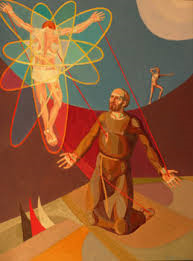
During the last years of his relatively short life (he died at 44), he was half blind and seriously ill. Two years before his death, he received the stigmata, the real and painful wounds of Christ in his hands, feet and side.
On his deathbed, he said over and over again the last addition to his Canticle of the Sun, "Be praised, O Lord, for our Sister Death." He sang Psalm 141, and at the end asked his superior to have his clothes removed when the last hour came and for permission to expire lying naked on the earth, in imitation of his Lord.
Comment:
Francis of Assisi was poor only that he might be Christ-like. He recognized creation as another manifestation of the beauty of God. In 1979, he was named patron of ecology. He did great penance (apologizing to "Brother Body" later in life) that he might be totally disciplined for the will of God. His poverty had a sister, humility, by which he meant total dependence on the good God. But all this was, as it were, preliminary to the heart of his spirituality: living the gospel life, summed up in the charity of Jesus and perfectly expressed in the Eucharist.
Quote:
"We adore you and we bless you, Lord Jesus Christ, here and in all the churches which are in the whole world, because by your holy cross you have redeemed the world" (St. Francis).
Saint Francis
Patron Saint of: Animals
Ecology
Italy
Merchants...
Francis of Assisi was a poor little man who astounded and inspired the Church by taking the gospel literally—not in a narrow fundamentalist sense, but by actually following all that Jesus said and did, joyfully, without limit and without a sense of self-importance.
Serious illness brought the young Francis to see the emptiness of his frolicking life as leader of Assisi's youth. Prayer—lengthy and difficult—led him to a self-emptying like that of Christ, climaxed by embracing a leper he met on the road. It symbolized his complete obedience to what he had heard in prayer: "Francis! Everything you have loved and desired in the flesh it is your duty to despise and hate, if you wish to know my will. And when you have begun this, all that now seems sweet and lovely to you will become intolerable and bitter, but all that you used to avoid will turn itself to great sweetness and exceeding joy."
From the cross in the neglected field-chapel of San Damiano, Christ told him, "Francis, go out and build up my house, for it is nearly falling down." Francis became the totally poor and humble workman.
He must have suspected a deeper meaning to "build up my house." But he would have been content to be for the rest of his life the poor "nothing" man actually putting brick on brick in abandoned chapels. He gave up all his possessions, piling even his clothes before his earthly father (who was demanding restitution for Francis' "gifts" to the poor) so that he would be totally free to say, "Our Father in heaven." He was, for a time, considered to be a religious fanatic, begging from door to door when he could not get money for his work, evokng sadness or disgust to the hearts of his former friends, ridicule from the unthinking.
But genuineness will tell. A few people began to realize that this man was actually trying to be Christian. He really believed what Jesus said: "Announce the kingdom! Possess no gold or silver or copper in your purses, no traveling bag, no sandals, no staff" (Luke 9:1-3).
Francis' first rule for his followers was a collection of texts from the Gospels. He had no idea of founding an order, but once it began he protected it and accepted all the legal structures needed to support it. His devotion and loyalty to the Church were absolute and highly exemplary at a time when various movements of reform tended to break the Church's unity.
He was torn between a life devoted entirely to prayer and a life of active preaching of the Good News. He decided in favor of the latter, but always returned to solitude when he could. He wanted to be a missionary in Syria or in Africa, but was prevented by shipwreck and illness in both cases. He did try to convert the sultan of Egypt during the Fifth Crusade.
During the last years of his relatively short life (he died at 44), he was half blind and seriously ill. Two years before his death, he received the stigmata, the real and painful wounds of Christ in his hands, feet and side.
On his deathbed, he said over and over again the last addition to his Canticle of the Sun, "Be praised, O Lord, for our Sister Death." He sang Psalm 141, and at the end asked his superior to have his clothes removed when the last hour came and for permission to expire lying naked on the earth, in imitation of his Lord.
Comment:
Francis of Assisi was poor only that he might be Christ-like. He recognized creation as another manifestation of the beauty of God. In 1979, he was named patron of ecology. He did great penance (apologizing to "Brother Body" later in life) that he might be totally disciplined for the will of God. His poverty had a sister, humility, by which he meant total dependence on the good God. But all this was, as it were, preliminary to the heart of his spirituality: living the gospel life, summed up in the charity of Jesus and perfectly expressed in the Eucharist.
Quote:
"We adore you and we bless you, Lord Jesus Christ, here and in all the churches which are in the whole world, because by your holy cross you have redeemed the world" (St. Francis).
Monday, September 22, 2014
Saint of the Day! Sept 22 St. Lorenzo Ruiz and Companions
Saint of the Day! Sept 22
St. Lorenzo Ruiz and Companions
(1600?-1637)
Lawrence (Lorenzo) was born in Manila of a Chinese father and a Filipino mother, both Christians. Thus he learned Chinese and Tagalog from them and Spanish from the Dom...inicans whom he served as altar boy and sacristan. He became a professional calligrapher, transcribing documents in beautiful penmanship. He was a full member of the Confraternity of the Holy Rosary under Dominican auspices. He married and had two sons and a daughter.
His life took an abrupt turn when he was accused of murder. Nothing further is known except the statement of two Dominicans that "he was sought by the authorities on account of a homicide to which he was present or which was attributed to him."
At that time three Dominican priests, Antonio Gonzalez, Guillermo Courtet and Miguel de Aozaraza, were about to sail to Japan in spite of a violent persecution there. With them was a Japanese priest, Vicente Shiwozuka de la Cruz, and a layman named Lazaro, a leper. Lorenzo, having taken asylum with them, was allowed to accompany them. But only when they were at sea did he learn that they were going to Japan.
They landed at Okinawa. Lorenzo could have gone on to Formosa, but, he reported, "I decided to stay with the Fathers, because the Spaniards would hang me there." In Japan they were soon found out, arrested and taken to Nagasaki. The site of wholesale bloodshed when the atomic bomb was dropped had known tragedy before. The 50,000 Catholics who once lived there were dispersed or killed by persecution.
They were subjected to an unspeakable kind of torture: After huge quantities of water were forced down their throats, they were made to lie down. Long boards were placed on their stomachs and guards then stepped on the ends of the boards, forcing the water to spurt violently from mouth, nose and ears.
The superior, Antonio, died after some days. Both the Japanese priest and Lazaro broke under torture, which included the insertion of bamboo needles under their fingernails. But both were brought back to courage by their companions.
In Lorenzo's moment of crisis, he asked the interpreter, "I would like to know if, by apostatizing, they will spare my life." The interpreter was noncommittal, but Lorenzo, in the ensuing hours, felt his faith grow strong. He became bold, even audacious, with his interrogators.
The five were put to death by being hanged upside down in pits. Boards fitted with semicircular holes were fitted around their waists and stones put on top to increase the pressure. They were tightly bound, to slow circulation and prevent a speedy death. They were allowed to hang for three days. By that time Lorenzo and Lazaro were dead. The three Dominican priests, still alive, were beheaded.
In 1987, Blessed John Paul II canonized these six and 10 others, Asians and Europeans, men and women, who spread the faith in the Philippines, Formosa and Japan. Lorenzo Ruiz is the first canonized Filipino martyr.
Comment:
We ordinary Christians of today—how would we stand up in the circumstances these martyrs faced? We sympathize with the two who temporarily denied the faith. We understand Lorenzo's terrible moment of temptation. But we see also the courage—unexplainable in human terms—which surged from their store of faith. Martyrdom, like ordinary life, is a miracle of grace.
Quote:
When government officials asked, "If we grant you life, will you renounce your faith?," Lorenzo responded: "That I will never do, because I am a Christian, and I shall die for God, and for him I will give many thousands of lives if I had them. And so, do with me as you please." See More
St. Lorenzo Ruiz and Companions
(1600?-1637)
Lawrence (Lorenzo) was born in Manila of a Chinese father and a Filipino mother, both Christians. Thus he learned Chinese and Tagalog from them and Spanish from the Dom...inicans whom he served as altar boy and sacristan. He became a professional calligrapher, transcribing documents in beautiful penmanship. He was a full member of the Confraternity of the Holy Rosary under Dominican auspices. He married and had two sons and a daughter.
His life took an abrupt turn when he was accused of murder. Nothing further is known except the statement of two Dominicans that "he was sought by the authorities on account of a homicide to which he was present or which was attributed to him."
At that time three Dominican priests, Antonio Gonzalez, Guillermo Courtet and Miguel de Aozaraza, were about to sail to Japan in spite of a violent persecution there. With them was a Japanese priest, Vicente Shiwozuka de la Cruz, and a layman named Lazaro, a leper. Lorenzo, having taken asylum with them, was allowed to accompany them. But only when they were at sea did he learn that they were going to Japan.
They landed at Okinawa. Lorenzo could have gone on to Formosa, but, he reported, "I decided to stay with the Fathers, because the Spaniards would hang me there." In Japan they were soon found out, arrested and taken to Nagasaki. The site of wholesale bloodshed when the atomic bomb was dropped had known tragedy before. The 50,000 Catholics who once lived there were dispersed or killed by persecution.
They were subjected to an unspeakable kind of torture: After huge quantities of water were forced down their throats, they were made to lie down. Long boards were placed on their stomachs and guards then stepped on the ends of the boards, forcing the water to spurt violently from mouth, nose and ears.
The superior, Antonio, died after some days. Both the Japanese priest and Lazaro broke under torture, which included the insertion of bamboo needles under their fingernails. But both were brought back to courage by their companions.
In Lorenzo's moment of crisis, he asked the interpreter, "I would like to know if, by apostatizing, they will spare my life." The interpreter was noncommittal, but Lorenzo, in the ensuing hours, felt his faith grow strong. He became bold, even audacious, with his interrogators.
The five were put to death by being hanged upside down in pits. Boards fitted with semicircular holes were fitted around their waists and stones put on top to increase the pressure. They were tightly bound, to slow circulation and prevent a speedy death. They were allowed to hang for three days. By that time Lorenzo and Lazaro were dead. The three Dominican priests, still alive, were beheaded.
In 1987, Blessed John Paul II canonized these six and 10 others, Asians and Europeans, men and women, who spread the faith in the Philippines, Formosa and Japan. Lorenzo Ruiz is the first canonized Filipino martyr.
Comment:
We ordinary Christians of today—how would we stand up in the circumstances these martyrs faced? We sympathize with the two who temporarily denied the faith. We understand Lorenzo's terrible moment of temptation. But we see also the courage—unexplainable in human terms—which surged from their store of faith. Martyrdom, like ordinary life, is a miracle of grace.
Quote:
When government officials asked, "If we grant you life, will you renounce your faith?," Lorenzo responded: "That I will never do, because I am a Christian, and I shall die for God, and for him I will give many thousands of lives if I had them. And so, do with me as you please." See More
Subscribe to:
Posts (Atom)